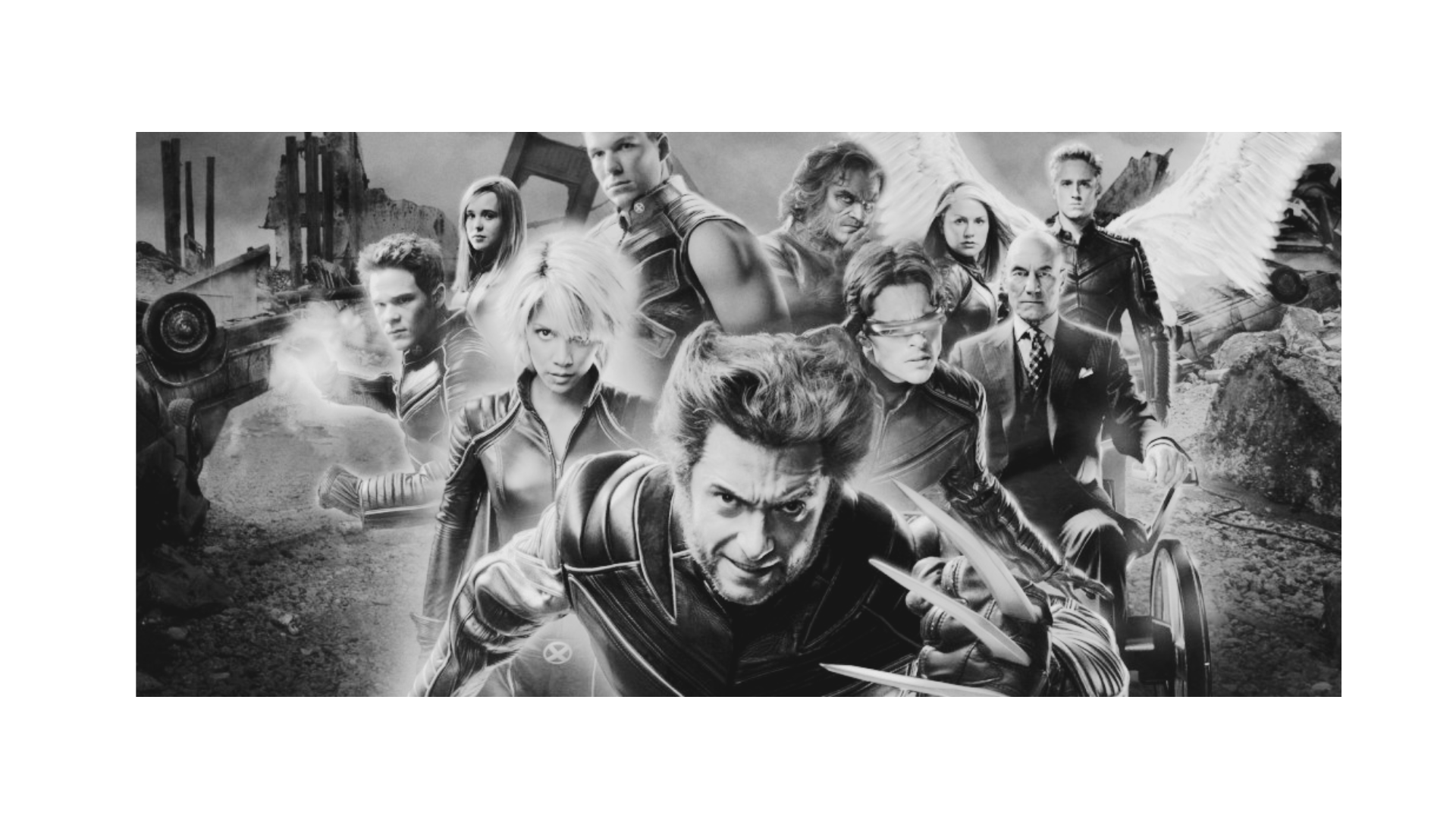
Growing up with X-Men
When I was a young child of about 6 or 7 years old, I used to wake up on Saturday mornings and eagerly run downstairs to plant myself in front of the television. When I wasn’t getting yelled at by my stepfather and was allowed to enjoy that day, I remember I loved watching the X-Men cartoon. It was my favorite. It was fantastic. I loved watching these spectacular super humans with unique powers and abilities, who were not part of society, but were the ones to save the day from the from the likes of the bad guy. The antagonist, coincidentally, was also usually an X-Men, just one that had not evolved in the same way. The X-Men were all taught at Professor Xavier’s School for Gifted Youngsters. I aspired to enroll in that school, wishing it existed in the real world.
I identified with the messages of diversity, uniqueness and belonging that emitted through the flashing screen of the tube to penetrate the subconscious of my precocious mind.
They were and are messages that resonate with me. I identified with the stories of the X-Men as coherent to my thoughts and feelings as a child. I thought I was an X-Man (woman), although did not know why.
This continued throughout my adolescence and into early adulthood.
The series of films that Hollywood distributed throughout the late 1990s and early 2000s on the X-Men were my absolute favorite. I have watched every single one, often more than once, paying close attention to each storyline, each character, each message that was being parlayed.
The films were spectacular. The visuals were astounding, and the world told they told through the lens of a screen continued to reverberate a message that is so real. The X-Men were ‘weird’, ‘different’, ‘other worldly’ and ‘special powered’ mutant versions of humans. They struggle through identification of who they are and why they are different. They are shunned by family or friends, and they must face their fears and their extraordinary abilities, mostly alone. Abilities that are like double-edged swords. One end being powerful and necessary; the other, being dangerous and deadly. As mutants, they had a different genetic code than humans, often passed on by a maniacal parental figure who turns out to be the villain of the series. This parent usually has neglected or abandoned their offspring, due their own traumatic experience, provoked and jaded by the actions of human beings, which leads them to be the anti-hero. The offspring are left not knowing the parent and wondering who they are or where they belong in the world.
Other times, the origin of the abilities are left unexplained, but the story of how the X-Man becomes super powerful, is a story of human abuse and manipulation. This is the story of Wolverine who is discovered by the military and whose claws superpower are distorted and made into metal as a weapon.
In summary, X-Men is a juxtaposition to everyday humanity. It is the exceptional behavior of a flawed figure in the face of the cruelties, injustices and vices of humankind. My soul and my mind were in sync with the messages relayed.
X-Men in the Real World
The X-Men stories, which have been told through multiple media from comics to film, are fiction. Fanciful stories of an imaginary world that we consume as entertainment.
The story they tell are a lot closer to reality. The creative industries have always had a knack for providing humanity feedback for their flawed existence through exaggerated, hyperbolic, and parodied fiction. Stories that human beings do not want to hear. As a species, it is difficult for us to be confronted so directly with our shortcomings, so we are instead entertained and amused by an indirect retelling.
The truth is the X-Men is the story of neurodiversity. Neurodiversity is the naturally occurring divergence in individuals that happens biologically through variation in brain function. It is the story of all those different minded and different bodied, for that matter, individuals that do not fit the “norm”.
For everyone who’s brain is wired differently and manifested through heightened use of their senses, sensitivities, and sensibilities, that is the story interpreted by Storm, Cyclops, Jean Grey, Beast, Rogue, Mystique among others.
Now, the X-Men find each other, or rather they are identified by Professor Xavier and brought together at his special school. This school becomes a safe haven, a community in which they can identify with each other, learn about who they are and why they are and grow in their abilities. The reality for extraordinary humans in society today is that there is not a collective space where they can be safe, identify and learn about what makes them who they are.
Inclusion among Humans
Psychologically speaking, inclusion is a difficult concept for most to externalize, the majority of people being normal bodied and minded humans. They have not had to struggle with identity or belonging, it has been a natural extension to their existence. As babies and children, when their development was fundamental, they exhibited behaviors that reinforced their “normality” and assured their parents, allowing them to easily embrace and accept them.
Neurodivergent individuals exhibit behaviors at an early age that are disconcerting to parents causing them panic and discomfort and not allowing them to fully accept who their children are. Even if the parents love their child, this has an early knock-on effect on the neurodivergent. Belonging to the nuclear family is predicated on the position that family at some point accepts the difference, in other words recognizes that they are excluding their own flesh and blood from their inner circle, and makes the active choice to include them. This, however, takes time and in the meanwhile the inconsistent and nervous behavior of the primary caregivers, has already had a psychological effect in what will become the attachment style of the adult. Some parents never understand what their neurodivergent child needs. Some will eventually acknowledge the difference, and if appropriately supported, can learn how to accommodate to their needs.
In society, we have an interpreted version of inclusion that is defined by the very people who have never had to question it. This definition of inclusion is the idea that we are all the same and that we should all be treated equally, also part of diversity and equality efforts. However, real world X-Men are largely excluded- especially in the institutions that humanity forms to organize themselves, specifically at school and in places of work.
Practices of inclusion in the educational setting vary significantly from country to country depending on the institution and the laws and norms of the society in which it exists. Some countries do a better job of inclusion in their national education systems than others. These countries may model a standard that is ideal for other countries but may not be as easily attained based on the type of government, cultural practices and beliefs that vary from one country to another. Wealth is also a consideration, as often the richer countries can subsidize specialized education that may accommodate to the needs of the neurodivergent that poorer countries cannot.
In the workplace, especially in private sector, inclusion conclusively falls short on a global scale. There is a lot of pandering, posturing, and pretending with key terms such as DEI and EDI being constantly hash tagged, but inclusion hardly takes place. The only conversation being contained to HR departments and with education among leaders, managers, colleagues and peers as non-existent.
The idea that practices and norms typical of a bustling office environment should change to accommodate those that are different, are hardly even considered. There is seldom a place for X-Men at work. Instead, they stay hidden behind the scenes or fly under the radar, lurking in the shadows. In fact, I think most neurodivergent people are best employed in social types of work, at non-profits or in the arts and other creative industries, specifically because those environments are more accommodating.
Instead, corporate has touted a message of DEI ‘Diversity, Equality and Inclusion’ which is mostly a façade.
Diversity is most often just limited a phenotype definition. If there is a representation of varying people of race and ethnicity, this seems to suffice for the business world, even then businesses are not doing a very good job at representation.
X-Men can be of any race or ethnicity, that is not the marker that makes them intellectually diverse.
Neurodivergent powers come from different brain patterns that develop and evolve and bring with them special skills and abilities that are beyond the grasp of those neurotypical people that run businesses.
Further, corporate defend equality without acknowledging true diversity. Being treated equally is being treated like everyone else- this ensures homogenization and facilitates coercion. Being recognized for your diversity and being treated with the accommodations necessary to allow you to succeed in your way, that is equity, a concept that is often disputed and rarely put into practice.
The truth is X-Men are exceptional, they are not ordinary and that scares most established businesses which are governed predominantly by the neurotypical human. They do not understand different at a cognitive level, because they are not different. Their sameness seeks out others that are on their wavelength.
If this hypothesis is correct, then can we ever have genuine inclusion without the world drastically changing?
- Can inclusion happen, when those at the helm are leaders who do not understand neurodiversity and fear what they do not know?
- Is it possible that we need neurodivergent leaders in order to have inclusive workplaces?
- Is inclusion even the right approach for all those who are brain different?
- Should there be unique schools and environments, such as at Professor X’s academy for all of those who are neurodiverse?
- Is authentic inclusion in an educational setting, achievable? If so do the results have long lasting effects into adult life?
I do not have the answer to these questions, but as I ponder my own isolated experience in these neurotypical, heterogenous, and uniform societies, I continue to seek identification and belonging in the world of the X-Men where fiction holds more truth than reality.

 Thinker. Dreamer. Lover
Leave a comment